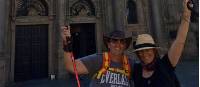
A Jacobean Year is very meaningful to Camino pilgrims. A year is considered a Holy Year or Jubilee when St James Day, the 25th of July, occurs on a Sunday. This makes the Sunday mass at Santiago Cathedral even more special than normal and extra functions take place.
In Galician, Xacobeo translates to Jacobean. To put it simply, Jacobean Holy Year 2021 and Xacobeo 2027 mean the same thing.
1. The Holy Door is opened. The Puerta Santa is a door located at the back of the Santiago Cathedral, and it stays open only during the Jacobean Holy Year.
Visitors to the Cathedral enter through the Holy Door and take part in a pilgrimage ritual. You descend to the tomb of St James before climbing a stairwell to exit to the outdoors. The symbolism is that the descent represents the pilgrimage, and the exit into the sunshine represents redemption and access to a new life.
2. Plenary Indulgence can be received. To gain this, pilgrims needs to pray, attend Mass and attend a Confession. For Christians, plenary indulgence is a way to be forgiven of all sins.
For the Catholic Church, plenary indulgence is ‘a way to reduce the amount of punishment one has to undergo for sins’. In a way, it’s like an amnesty from punishment in the afterlife.
A plenary indulgence is granted to those who visit the tomb of St James during a Jacobean Holy Year.
2027 is a Jacobean Holy Year because Saint James Day, the 25th July, falls on a Sunday.
For Jacobean Year 2027, pilgrims are especially enthusiastic to commemorate St James Day because it has been 6 years since the last Holy Year.
When was the Last Jacobean Year (ano Jacobeo)?
The last Jacobean Holy Year was shared between 2021 and 2022, because the Pope declared 2022 a Jacobean Year following the pandemic.
The next Jacobean Holy Year takes place in 2027. After that it will be in 2032, 2038, and so on.
A Jacobean Holy Year happens when St James Day falls on a Sunday, and this follows a pattern in year groups of 6, 5, 6, 11. There are approximately 14 Jacobean Holy Years every century.
According to the editor, pronouncing Xacobeo sounds like: Shak-o-bay-o. Hear genuine pronunciations by Galicians here.
According to Google, Jacobean is pronounced like this: ja-kuh-bee-uhn. Hear audio of their pronunciation of Jacobean here.
Jacobean Era. This refers to the period in English and Scottish history when James VI of Scotland inherited the crown of England in 1603.
Jacobite/Jacobitism. This is a 17th century movement in Great Britain that sought to restore King James to the British throne.
Jacobean flowers. These are embroidered floral patterns that rose to fame during the Elizabethan era. They look pretty but you won’t see them while walking the Camino de Santiago. View some examples of Jacobean flowers here.
What does the Jacobean Holy Year have to do with the Alchemist? This is an interesting coincidence of facts, dates, history and the arts. In the 17th century, The Alchemist was a comedic play written by the English playwright Ben Jonson. He depicted life in Jacobean London.
Purely coincidentally, The Alchemist is a modern day novel written by famed Brazilian author Paulo Coelho in 1988. Coelho has also written an acclaimed book on the Camino, titled The Pilgrimage, which is part adventure story, part guide to self discovery. Read our take on his inspiring book here.
As you can see, seven degrees of separation between Ben Jonson and the Camino de Santiago!
Do you have any more questions about walking your Camino de Santiago pilgrimage during the Jacobean Holy Year? If so, please don't hesitate to contact our friendly team of Camino experts.