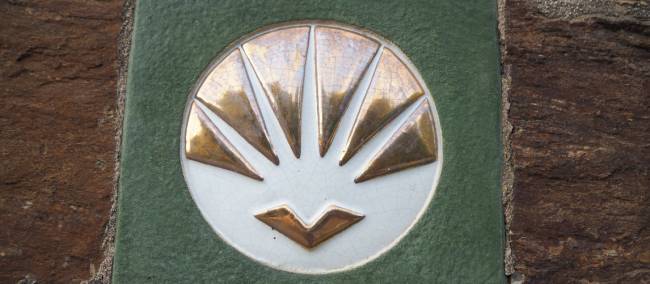
The shells and arrows that mark the Way can be found everywhere on the Camino | Sue Finn
Different Camino Routes in Spain
The endpoint of many Camino journey's is the city of Santiago de Compostela, which is the capital of an autonomous community in Spain's northwest. Naturally, Spain has the majority of Camino routes snaking their way through the countryside to reach this spiritual destination. The umbrella name for a Camino trail in Spain is the Camino de Santiago.
The main Camino de Santiago trails in Spain are the Camino Frances, the Camino del Norte, the Camino Primitivo, the Camino Ingles, the Camino dos Faros (the Lighthouse Way), the Camino Sanabres, and the newest official route, the Camino de Invierno.
In this article, we'll describe the different Camino routes in Spain. This information should help you choose the best Camino tour to walk or cycle.
Camino Frances

Pilgrims walking across the Pyrenees from France, or beyond, typically followed a route similar to what is today known as the Camino Frances, or the French Way.
The Camino Frances is by far the most popular route. The full trail starts in the charming French town of St Jean Pied de Port and continues for 36 days. On average, over 60% of all people who walk along a section on any of the seven main Camino pilgrimage routes follow this path to Santiago de Compostela.

These numbers are bolstered by the fact that the most popular starting point for today’s travellers is the delightful town of Sarria, which conveniently sits 115km from Santiago, just enough for people to earn their official Compostela certificate and complete within a week.
The Camino Frances is also the longest of all the widely recognised Camino routes, offering hardier pilgrims and walkers a tougher challenge, and a more complete Camino experience passing by a multitude of churches and famous towns, such as Pamplona, Logroño, Burgos and Leon, as well as a variety of landscapes from the mountains of the Pyrenees to the Rioja winefields, the vast meseta and the rolling green hills of Galicia.
Camino del Norte (Northern Way)

The Northern Way follows the northern coast of Spain through dynamic cities such as San Sebastian, Santander and Bilbao. This Camino travels to Santiago via the towns of Gijón and Ribadeo, however many early pilgrims preferred to connect with the Camino Primitivo in Oviedo thanks to King Alphonso II making it a safer and more well known path.
The full Camino del Norte starts in San Sebastian and takes 41 days to reach Santiago de Compostela.

Given its coastal route, the Camino is also referred to as the “Ruta de la Costa”, Route of the Coast, and it became an important way for Christian pilgrims when the Camino Frances became dangerous due to the Moorish invasion of the Iberian Peninsula. Following the coast was also deemed easier than trying to traverse the Cantabrian Mountains and it provided a cooler option in summer.
Camino Primitivo (Original Way)

The Camino Primitivo is thought to have been the very first pilgrimage route to Santiago, hence it is also known as the Original Way.
On hearing that the bones of the Apostle James were miraculously unearthed in Santiago, King Alphonse II of the Asturias made the treacherous journey in the 9th century from Oviedo via Lugo to Santiago and eventually was accredited with confirming the relics.

This pilgrimage path has always been considered more challenging, crossing mountains and passing through dark woods. The Full Camino Primitivo takes 17 days to complete.
Today, the Camino Primitivo links the Northern Way with the French Way, joining it in Melide. The path offers a quieter trail through beautiful natural settings and gorgeous rural farmland, passing through the authentically friendly villages of northern Spain.
Camino Ingles (English Way)

The Camino Ingles, or English Way, came about in the 12th century when boats of pilgrims from England, and Nordic countries, arrived in the north of Spain to embark on their pilgrimage to Santiago. Those that came via the ‘seafaring way’ would land at A Coruna, which is the shortest and most direct route to Santiago (96km). This is not long enough for today’s pilgrims to earn their Compostela hence most begin from Ferrol, which is 110km from Santiago.

The Camino Ingles is the least travelled at an average of only 4% of all pilgrims taking this route. There are no major cities along the route, just tiny villages where locals often speak Galician over Spanish.
Camino Finisterre
The Camino’s kilometre zero is not Santiago, it actually lies on the Galician coast which was considered the ‘end of the world’ in the Middle Ages. Finisterre derives from Latin, ‘finis terrae’ translating to ‘end of the earth’.
Many early pilgrims would continue the extra 90km from Santiago to collect the scallop shell to prove their successful pilgrimage. Traditionally, the Camino Finisterre concludes at Cape Fisterra however many who choose this option hike the extra 6km along the coast to Muxia to enjoy the wild Atlantic coastal views.
If you've got the time, it's worthwhile adding the Finisterre stage onto your Camino journey. There's something quite unique about walking to the edge of Spanish land, and to reach the 0km mark!
Camino Sanabres
Walk one of the oldest Camino routes that actually predate Christian pilgrims, going back to when Celt, Phoenician and Roman traders travelled the lands.
The Camino Sanabres starts in Ourense, a historic old city full of bustling tapas restaurants and therapeutic thermal springs. Follow quiet lanes through rural hamlets, view the impressive Trappist monastery in Oseira, and be warmly welcomed at your cosy lodgings. Walk the final stretch past charming chapels and picturesque vineyards before arriving in Santiago, where you can collect your Compostela (completion certificate) and reminisce about your journey on foot over plates of Galician delicacies.
Camino de Invierno (Winter Way)
The Camino de Invierno, or Winter Way, was created by pilgrims who were walking to Santiago during the winter months and wanted to bypass the high elevation and snowfall at O Cebreiro. It is the newest Camino route to be recognised as official (in 2016) and offers vineyrads, rivers, remote landscapes, rural scenery, and off the beaten track encounters with the small villages and townships along the way.
More Camino Information
>
View all Camino de Santiago tours
>
View all Camino tours.
>
View more Camino information.
>
Join UTracks' Active Travel Community.
Which Camino route will you be making your pilgrimage along? Let us know in the comment section below.