Follow the Camino shells | Allie Peden
Blog home / Understanding the Camino: Camino Glossary
Understanding the Camino: Camino Glossary
For a first time pilgrim looking to walk the Camino de Santiago, it can be quite daunting to fully understand the various terms and routes of the Camino. There's a complex network of phrases and walks that have evolved over many years. To help you on your way, we've created a Camino glossary so you can better understand this iconic trail. If you have any further questions, please write a comment or get in touch with our friendly team of Camino experts.
Camino Glossary
Camino: This Spanish word simply means a path of travel, or route. When written as ‘el camino’ it translates to ‘the way’.
Santiago: The name Santiago is linked to the Apostle James (Saint James meaning Santiago). He travelled to the most north-western part of Spain to preach and convert people to Christianity.
The Way of St James: The origins of the Camino began in the 9th century when the tomb of the apostle St James was unearthed in the city of Santiago de Compostela. Early Christian pilgrims to Santiago began their ‘Camino de Santiago’ (Spanish name), or ‘Way of St James’ (English name), from their front door.
Santiago de Compostela: Also known as Saint James of Compostela, it is a Spanish city, the capital of the region of Galicia.
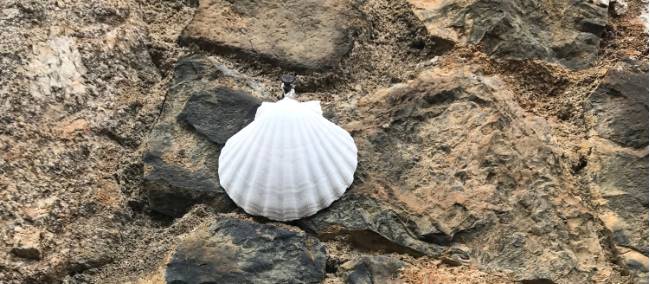
The Compostela: the official accreditation proving one's pilgrimage to the tomb of St James in the 9th and 10th centuries. It was originally provided in the form of a scallop shell badge which proved easy to forge and was eventually replaced by the Compostela certificate.
Compostela certificate: A document one receives from the Pilgrims Reception Office in Santiago. To receive the certificate you must make the pilgrimage for pious reasons (or at least have an attitude of search), walk (or ride on horseback) the last 100km or cycle the last 200km, and collect stamps in the Credencial del Peregrino from places you pass through.
Certificate of distance: Document on parchment paper certifying the numbers of kilometres walked, which can be provided in addition to the Compostela certificate. A small payment is required to receive this certificate.
The Credencial del Peregrino: In the Middle Ages the document was provided to pilgrims as a safeguard. Also referred to as the Camino Passport or Pilgrim's Passport, today the document can be collected from various authorised places and is used to collect stamps along the way so one can prove their journey when collecting their Compostela certificate.
Testimonium: A Testimonium is the Italian equivalent of the Camino de Santiago's Compostela, or Pilgrim's Certificate. It signifies that the holder has walked or cycled the necessary distance to complete the Via Francigena. According to the
European Association of the Via Francigena, it certifies that the pilgrimage was undertaken in a religious spirit.
Do you have any other questions about the Camino? Visit our Camino FAQ page or write a comment below and we'll get back to you as soon as possible.