Blog home / Traveller Tale: Tali Walks the Lechweg Trail
The Lechweg Trail: A Wonderful Alpine Walk Without the Big Passes
By Tali Emdin
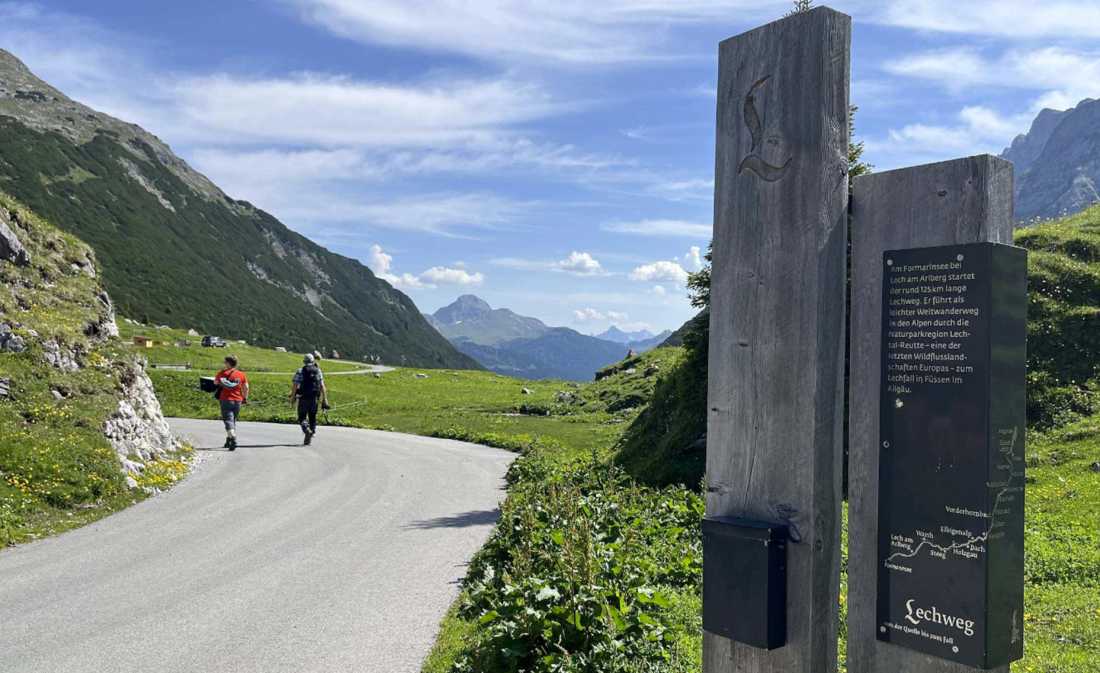
The Lechweg Trail is an 8 or 10 day self-guided walk of approximately 125km, following the turquoise Lech River from its source at Lake Formarinsee, near the alpine village of Lech am Arlberg in Austria, to the Lechfall waterfall in Füssen, Germany. I walked the eight-day version, the Lechweg Trail Hike, from 20 to 27 June 2026 in the middle of a heatwave.. The itinerary is graded Moderate (Grade 3) and includes overnight stays in comfortable 3 or 4 star hotels and the 'Lech Card' (more on what this is below).
The trail officially opened in 2012, created to protect one of the last remaining wild river landscapes in Europe. Unlike many Alpine rivers that have been heavily dammed or channelled, the Lech still flows naturally for much of its length, creating a network of gravel banks, channels and floodplain forests.
Overall Impression
The Lechweg turned out to be a wonderful Alpine experience, without the big mountain passes and long ascents and descents I might have expected. The scenery was outstanding throughout: beautiful alpine villages, turquoise rivers, mountain lakes. Navigation was generally straightforward, and we hardly needed the app, since the waymarking on the ground is excellent.
Having not walked in an alpine environment before, I was surprised at how gravelly the tracks are. You're walking on forestry access roads and gravel paths that are extremely hard and rocky underfoot, and in the forests there are tree roots and rocks to watch for the whole way. Hiking poles were extremely useful.
A lot of the walk is exposed, so in 32 degrees it was hot. We took every opportunity to dip our hats and feet into the river and streams, or go for a swim.
Day 1: Arrival in Lech am Arlberg
Our hotel was run by a lovely mother and daughter team, right next to the cable car station in the centre of town. We arrived on the summer solstice, so that evening we used our Lech Card to catch the Rufikopf cable car up to the top station, where they'd lit a bonfire and set out lanterns around the tracks. The restaurant up there stayed open late, so we had a traditional Austrian dinner with the view.
Day 2: Formarinsee to Lech am Arlberg (14km)
The first walking day starts with a bus up to Lake Formarinsee, sitting at 1,793m beneath the limestone cliffs of the Rote Wand and marking one of the main sources of the River Lech. It's a striking spot, and not just to my eyes: it was voted Austria's most beautiful place in 2015. The lake circuit is about 4km, well maintained on the first half, before turning into proper alpine walking on the second, with rougher terrain and the occasional need for a hand on the rock.
The descent back to Lech, by contrast, is a gentle, easy walk through alpine meadows, and the mountain scenery is stunning. Visually this was the most gorgeous of all the days. Near the end of the walk we reached the local swimming pool by the river, free with the Lech Card, and stopped for a beer and a dip before heading in for the night.
Day 3: Walk to Warth, then on to Steeg (26km)
If you finish in Warth, you can start later and catch the bus the rest of the way to Steeg. Being purists, we walked the full day, which the trip notes actually rate Moderate to Challenging if you skip the bus and walk the whole section, so it's not just us being precious about it.
Starting uphill out of Lech, you walk along the Lech Valley, crossing fields with great views of the surrounding mountains, before some steep sections through forest above Lech Gorge. From Warth, the trail follows a lovely panorama route above the river, through fields of spring flowers, with views down to the Lech's turquoise water the whole way.
The final descent into Steeg is a gravel switchback road, about 4km, and it was the least enjoyable stretch of the day, hard on the knees after that much walking already. There was a small mercy at the bottom: a drinks trough with an honesty box. The heat was real. We followed the river the rest of the way into Steeg, inside the Lechtal Nature Park, and were spent by the time we reached our hotel that night.
Day 4: Walk to Elbigenalp (18km)
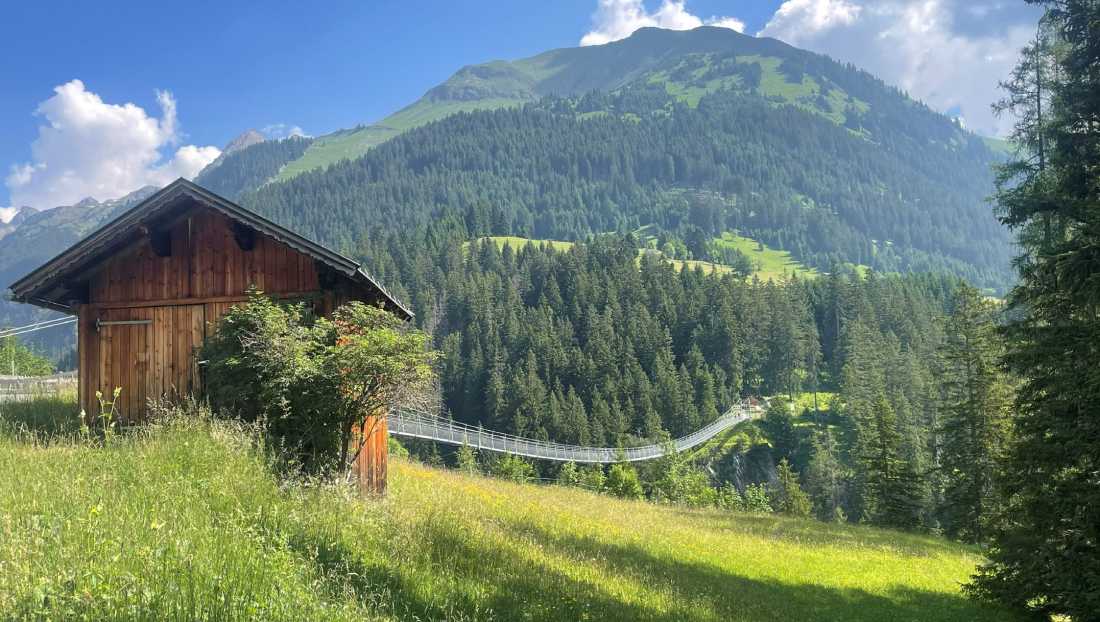
This was a good day. The trail runs beside the river to Holzgau, a village of brightly painted houses, before the walk's signature moment: a 200m suspension bridge, with an honesty box to cross it that nobody's actually policing. I'll admit I took Scott's word for the views. Heights aren't my thing.
Further on you pass the Jochelspitzbahn cable car, and we rode it up for a proper lookout over the ground we'd already covered, before continuing through meadows and forest paths the rest of the way to Elbigenalp.
Day 5: Walk to Stanzach (20km)
From Elbigenalp, the trail continues through the heart of the Lechtal Nature Park, on forest paths, open meadows and riverside trails, through the villages of Häselgehr and Elmen, where traditional Tyrolean farmhouses reflect the region's alpine heritage.
As the trail approaches Stanzach, the river broadens into one of the largest gravel riverbeds in the Alps. It reminded us both of rivers in Alaska. Our guesthouse that night had an owner keen to talk about the solar panels covering his roof; at one point I looked outside and found Scott and another guest up ladders inspecting them with him. Dinner came with a translation mishap: we thought we'd ordered a steak sandwich and got pork in a sauce neither of us could identify.
Day 6: Walk to Höfen (19km)
After five days of climbs and descents, this one is close to flat, gravel underfoot most of the way and the river close by for company. The trail passes through Forchach and skirts the Lechzopf, a braided stretch where the water splits into multiple channels weaving through gravel banks, one of the wildest-looking sections of the whole valley.
The highlight was a quarry lake about two-thirds of the way in, clear and cold enough that we didn't want to get out. If I were doing this day again I'd leave later and give the quarry a few real hours rather than a quick stop.
Day 7: Walk to Pflach or Füssen (26km)
You could feel the nervous tension in the breakfast room, with people deciding what to do; I believe the heat was a deciding factor for a lot of walkers. There were three options: bus part of the way, take a shorter river route that misses the lake, or walk the whole thing. We went the long way, and this is the other day the trip notes bump up to Moderate to Challenging if you walk it in full.
The walk starts along a panoramic path above the Reutte valley, then a short, steep climb to the Costaries Chapel, where there are shaded seats. From there it's downhill through forest to Frauensee, a swimming lake, where the heat made a quick swim non-negotiable before we carried on.
Crossing the railway line marks the start of a steady climb towards the German border, and the forest genuinely changes character as you approach it: thicker vegetation, no logging, noticeably cooler air. Scott walked back and forth over the actual border marker a few times just to be sure it was real. From there the trail switchbacks down through forest to Lake Alpsee, with Hohenschwangau and Neuschwanstein castles visible across the water. We took the wrong side of the lake hoping for a swim and didn't find one, which turned the last stretch into more of a trek than we'd planned, made harder by the heat. The trail finishes at the Lech Falls after a climb up past Kalvarienberg and its churches. Walked as signposted, it's a 32km day.
From the falls it's another twenty minutes into town, and we stopped by the river one last time to dunk our feet, Scott went in fully, before heading to our hotel.
Should You Walk It?
Absolutely, for those wanting a moderate grade walk that isn't too hard on the knees (poles recommended), that lets you hike through lovely alpine environments while staying in traditional Austrian accommodation. Most sections have the option of a bus to shorten the day if the heat or the distance gets to you.
Who doesn't want to catch cable cars in the middle of their walk and marvel at the surrounding views while enjoying a Radler? Who doesn't want to go swimming in alpine lakes, rivers and quarries?
How fit do you really have to be? A moderate level is enough to enjoy it, though the heat made it harder than expected during our week, especially on the long exposed sections.
Thanks to Scott, for being my model for most of the pictures, and to my physiotherapist: I don't think I've ever travelled with so much ibuprofen, kinesiology tape, resistance bands and recovery balls. My Achilles made it!
>> View the Lechweg Trail Hike (8 Days)
>> View the Lechweg Trail Hike (10 Days)
>> View all Alpine Hiking trips