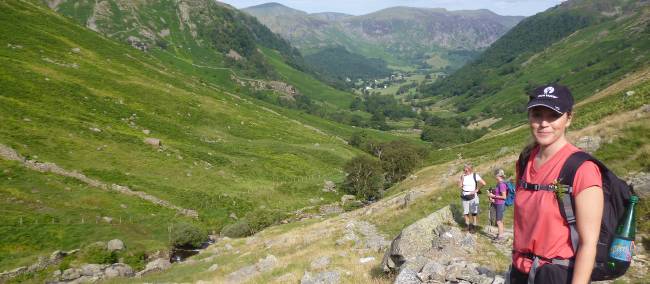
Taking a rest on the Coast to Coast | Jaclyn Lofts
Blog home / Essential Advice for England's Coast to Coast
Essential Advice for England's Coast to Coast
Read the best tips from people who have walked Wainwright's Way
England's Coast to Coast trail is the most famous long-distance trail in the UK, crossing from St Bees on the west coast to the North Sea at the charming fishing village of Robin Hood’s Bay. At 315km or 195 miles, it not only spans the breadth of England, but takes you through three national parks and a huge variety of landscapes and terrain including the magical Lake District and the rolling hills of the Yorkshire Dales.
Our
guided and
self-guided Coast to Coast holidays range from 15 to 18 days, or you can elect to do the first or second half of the trip if you are short on time. Alternatively, if you're a cyclist you can
cycle the Coast to Coast in just 6 days.
We sat down with our Active Europe specialist Jaclyn, who has previously walked the entire Coast to Coast, and found out her top tips for tackling this challenging walk.

1. Don't Forget to Wash Your Boots
...in the Irish Sea, before you set off from St Bees. Tradition says you should also collect a pebble from the beach there too. Then, when you reach the North Sea at Robin Hoods Bay, dip your boots in the water there and release your pebble.
My group was excited and proud when they took turns dipping their toes in the sea at Robin Hood’s Bay having walked the breadth of England. Completing this walk is no small feat!
2. Don't Underestimate the Trail
A diverse mix of terrain, unpredictable weather and huge distances covered every day make this one of our hardest walks in not only the UK but also in Europe. Your level of fitness needs to be very good and you need to be comfortable climbing over wood styles and dry stone walls. This walk is not recommended for people who have never done a multi-day trek before.
Self-guided walkers need to have some experience map reading and navigating – diversions due to forestry work and flooding are not uncommon, and often you will walk for hours without seeing another soul, with very patchy mobile phone coverage. In saying this, we do not seek to deter people – for serious walkers, completing this trail is a huge accomplishment!
The days are long, the terrain is at times challenging and you need to be prepared for any weather – fair weather walkers need not apply! Think slippery clay mud, bog, grass, stony tracks...
3. Consider Adding Rest Days into your Itinerary
Rest days offer you a chance to get out of your muddy walking boots for the day and rest your weary feet. You can also use them to do laundry and start afresh the next day with clean and more importantly, dry clothes.
Talk to your local UTracks office and we'll be able to recommend the best towns for rest days in advance so you don’t end up getting stuck in a one-street town with a corner store and a pub – unless that sounds like your cup of tea. It’s best not to take rest days on a Sunday because many shops and services close.
Kirkby Stephens, which is about half-way through the trail, is a good place to have a rest day, restock on supplies and do laundry.
If people have the time, I always recommend that they do either the 18-day guided or self-guided trip and add in rest days, because it really is one of our more physically and mentally challenging walking holidays.

4. Prepare for rain
Even if you go in the middle of summer, you should expect some bad weather. In addition to a good water and windproof jacket, invest in a waterproof pack cover to protect your belongings from relentless rain. A comprehensive gear list is provided on booking.
Four days of non-stop rain at the very start of my trip (which was in August!) did not make for easy walking. I was so grateful I had a visor, which kept the rain off my face at the start of the trip and the sun for the remainder.
5. Bring a Tupperware Container
It isn’t possible to stop for a pub lunch every day of your trip. Bring a Tupperware container for those days that you have to bring your own lunch to stop your packed lunch getting squashed and soggy.
Self-guided walkers are provided with a guidebook and notes which they can read the day before so they know when they need to order a packed lunch from their accommodation or organise lunch in advance.
After the Coast to Coast, a Tupperware container has become a staple for me when I go on hiking and cycling trips.

6. Book early
Accommodation is limited along the Coast to Coast trail. If you are in a party of six or more, be sure to book well in advance so you can stay together in the same accommodation.
We stayed in one B&B in Grasmere that only had two rooms. In this town our group was spread across five different places.
7. BYO tea or coffee
There are few things as comforting as a warm drink in miserable weather. There are rarely any stops for hot drinks during the day, but you will have tea and coffee-making facilities in every room you stay in, so a thermos would make a great addition to your packing list.
Particularly in cold weather, having a thermos of tea or coffee is a real treat. Lucky for us our guide John was happy to share his thermos of coffee around.
7. Invest in Walking Poles
Poles really do come in handy on the Coast to Coast walk because of the varied and often slippery terrain, including streams that you have to rock-hop across.
Whilst I don’t usually use them, they are extremely useful for this walk and more than half of our group were using them and very happy to have them for extra stability in slippery terrain.

Find out more about our range of Coast to Coast walking holidays today:
>> Guided
>> Self Guided