Meal time in Bavaria | Tim Charody
It's Oktoberfest time!
 Munich, with the Bavarian Alps in the background
Almost every country has its own version of Oktoberfest but it’s the Munich Oktoberfest that is the world’s largest folk festival. It has attracted an average of six million visitors a year who then consume almost seven million litres of beer, thousands of bratwursts, chickens, giant pretzels, wild oxen and even gingerbread.
The first Oktoberfest was held in October 1810 to honour the wedding of Crown Prince Ludwig of Bavaria and Princess Therese of Saxony-Hildburghausen (hence the name Theresinwiese). For five days, the townspeople of Munich were invited to eat, drink and be merry to celebrate the union. There was even a horse race! The event was so enjoyed that the decision was made to stage the race and continue the indulgences every year.
Featuring colourful parades, fairground rides, eating, drinking and dancing, and of course that horse race, today Oktoberfest is known for traditional Bavarian gear, beer and food.
The Beer
 Pouring Beer at a Bavarian brewery
With more than 200 breweries in Franconia,
UTrack’s Beer Cycling Route offers an average brewery per kilometer in the Aisch Valley. This is the highest concentration of breweries in the world! Further, due to the oldest food regulation in the world, the “Bavarian Beer Purity Law” also referred to as the “German Purity Law” (Deutsches Reinheitsgebot), Bavarian beer is second to none as you’ll only find hops, malt, yeast and water in your stein – nothing else.
Fun Fact: Wheat beer – one of the things that Bavaria is famous for – was outlawed by the 1516 ordinance as the rulers wanted people to use wheat for making bread.
The Food
Oktoberfest is not just about beer in Bavaria, it’s also home to a wealth of culinary delights. Today’s Bavaria includes what was Franconia and part of Swabia, so both Franconian and Swabian cuisine are considered to be part of Bavarian cuisine. Here are just a few of the tantalising tastes you will find…
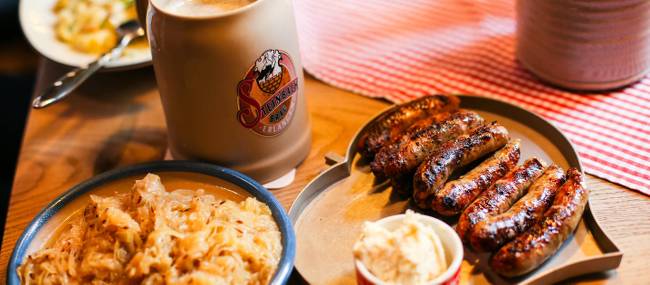
 Alter Simpl Nuremberger Sausages
- Bratwurst: A type of sausage, whose name is derived from the Old High German brätwurst. Brät meant finely chopped mean and Wurst is sausage. That being said, in modern German, it is associated with the verb braten which means to pan fry or roast.
- Lebkuchen: One of the most famous delicacies, this is a ginger bread. Traditionally, these biscuits were served with mulled wine between August and Christmas.
- Haxn: Always fresh from the oven, these pork knuckles are known for their crispy pork fat layer. It is commonly served with sauerkraut and a hearty sized dumpling.
- Brezn: Brezn, or Bavarian pretzel is a salty specialty made from yeast dough and gets its unique flavour from being dipped into caustic soda before baking.
- Weisswurst: Made from pork and veal, this white sausage is made with ordinary table salt rather than nitrite curing salt, which causes the white colour. Typically served in the late morning with sweet mustard, sauerkraut and a glass of beer.
Sights to See
 Breathtakingly beautiful, Bamberg is a UNESCO World Heritage Site
Bavaria has a breathtakingly beautiful landscape and is home to art museums, the UNESCO heritage listed Bamberg, and Nuremberg, known for its colourful history and of course many, many local breweries.
Active Holidays To Plan Pre/Post Oktoberfest